.svg)

.svg)

What E-World 2026 revealed about the future of EV charging
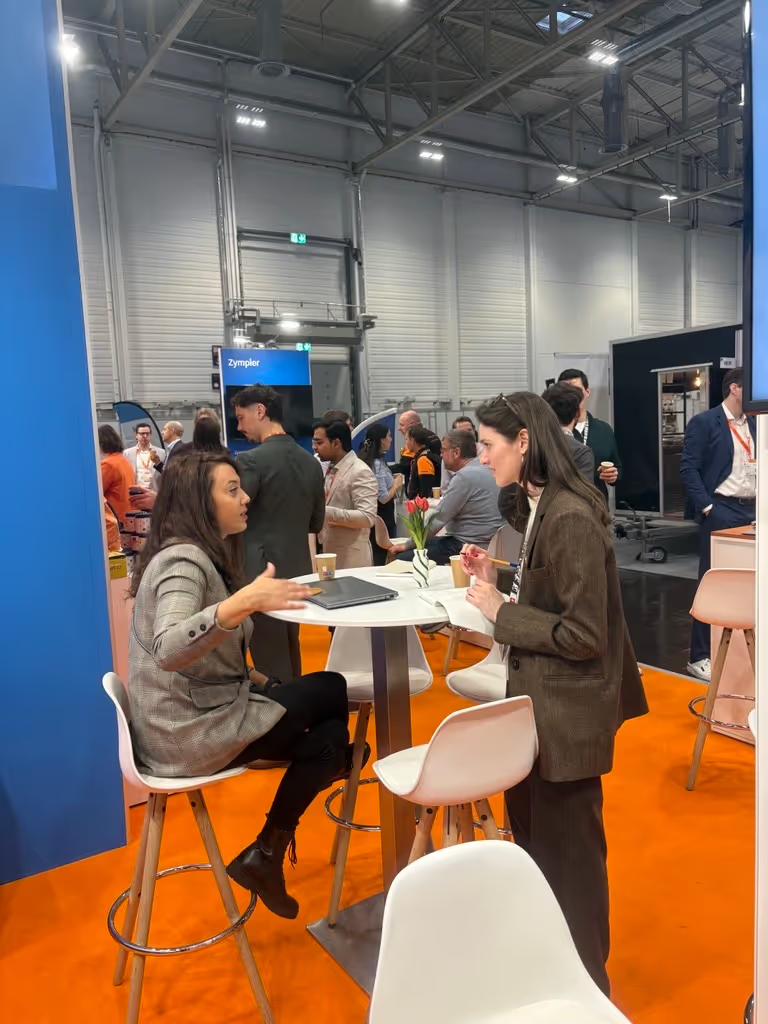
The real value of attending industry events is getting wind of the insights that everyone seems to circle back to. Here are the three themes that dominated conversations at E-World energy & water in Essen this year and that will be shaping industry decisions for the year ahead and beyond.
Buying EV flexibility, the proven opportunity waiting for market alignment
Across panels and booth conversations, one theme kept coming back up: the market is ready to buy EV flexibility, but alignment is lagging. The technical capability behind Smart Charging is no longer in doubt; large-scale pilots have already shown that charging can be shifted to off-peak to reduce congestion.
The dominant discussion centred on how to align actors across the ecosystem to deploy Smart Charging at scale. Scaling now depends on coordinated action across the value chain, as the players who operationalise this first are likely to capture both tariff advantage and customer loyalty.
V2G partnerships starting to take shape, but market still not ready for scalability
V2G partnerships are beginning to emerge, with utilities and OEMs piloting bidirectional charging that allows EV batteries to both draw power from and feed power back into the grid. In theory, this can support grid stability and optimise energy use.
However, we heard from different EV market players how scaling such offers raises practical questions around departure times, required state of charge, charging speed and the real-time cost of energy already in the battery. These variables are the key factor in determining how much flexibility is actually available in any given session, and therefore, how dependable V2G can be.
Everything indicates that before V2G can scale reliably, V1G Smart Charging must be fully standardised and deployed at volume. Otherwise, it risks remaining limited to pilots rather than scalable market solutions.
Software remains the key differentiator in the EV charging journey
Software is what shapes the EV driver experience, and that was clear in the discussions we had at E-world this year. While hardware continues to expand the network, the real concerns we heard from visitors to our booth were about interoperability, scalability and client satisfaction, all of which ultimately depend on the intelligence and adaptability of the software layer.
For EV charging, the biggest priority remains delivering a frictionless and transparent interaction to the driver. If we want to accelerate EV adoption, investment in smart, interoperable software that improves the driver experience must remain central to the strategy.
Next stop: Intertraffic (10-13 March)
These conversations will continue at Intertraffic in Amsterdam next month, where the focus is expected to be on determining who can capture the value of Smart Charging’s flexibility at scale.
