.svg)

.svg)

How aggregating EV flexibility turns charging behaviour into a reliable grid-balancing resource
The European Union set out in the EU Electricity Directive 2019/944 that renewable energy targets would be more effectively met through a market framework that rewards flexibility and innovation. For that, the European Innovation Council (EIC) awarded Deftpower €2.5m through its Accelerator programme to advance this model into real-world application.

Existing capacity remains underused due to demand timing
Grid congestion is limiting the pace of the energy transition across Europe. Delayed new connections for housing, curtailed renewable energy and increased infrastructure restrict economic growth in the Netherlands alone by €35 billion per year. This pressure is driven by imbalanced electricity demand, where peak moments exceed available capacity. To accelerate solutions that can address this imbalance, the European Innovation Council (EIC) awarded Deftpower €2.5 million through its Accelerator programme to advance this model into real-world application.
Across the industry, average grid utilisation is cited at approximately 25%, implying that up to four times more electricity could be carried by existing infrastructure if demand is better distributed. Electric vehicles can significantly contribute to this by shifting electricity to periods of lower demand, with active incentives for EV drivers being the solution to scale this system-level balancing.
In practice, EV charging remains distributed across millions of individual drivers, each with their own routines and timing. Even though vehicles are connected for long periods, charging decisions remain individual –they can be charged for one, five or 10 hours– making demand fragmented, difficult to predict and not directly usable in grid operations. This is where aggregation becomes essential.
Transitioning from fragmented demand to system-level flexibility
On an individual level, charging behaviour is too small and variable to influence grid conditions. Aggregated across large numbers of vehicles, however, this behaviour becomes structured and predictable. Instead of isolated charging sessions, a coordinated portfolio of EVs forms a flexible demand resource that can be forecasted and aligned with system conditions. Only at this level does EV flexibility become operationally relevant for congestion management.
For that it must meet three conditions:
- Predictability: Understanding how much demand can be shifted and when.
- Controllability: The ability to influence charging in response to grid conditions.
- Scalability: Sufficient volume to impact local or regional grid constraints.
Without aggregation, these conditions are not met, and EV demand remains outside effective grid control.
How EV demand is structured into a controllable grid resource
To operationalise this model, Deftpower developed DEVA, an EV aggregation service that structures distributed charging demand into a single, controllable resource. DEVA builds on the role of the mobility service provider (MSP), the primary interface between driver and charging session. Through this layer, charging behaviour can be coordinated using real-time inputs such as state of charge, departure time and user preferences, and is already being piloted with a European distribution system operator (DSO) to integrate aggregated EV demand into real-world grid operations.
Aggregated across large numbers of vehicles, this data forms a virtual power plant of EV demand. Charging demand is then forecasted and shifted in line with grid conditions, creating a direct interface between EV demand and system needs. Grid operators can then estimate available flexibility in advance and shift demand away from constrained periods, integrating EV charging into operational planning. EV demand therefore moves from being an uncertainty to a controllable and increasingly reliable component of the system.
Improving grid utilisation through coordinated demand
Aggregating flexibility does not require new hardware or behavioural change from scratch. It builds on an existing ecosystem of connected vehicles and mobility platforms. Today, 97% of public charging transactions in Europe are handled through mobility service providers, which already act as the main interface between drivers and charging. This creates a coordination layer that allows charging behaviour to be actively shaped through incentives and user preferences.
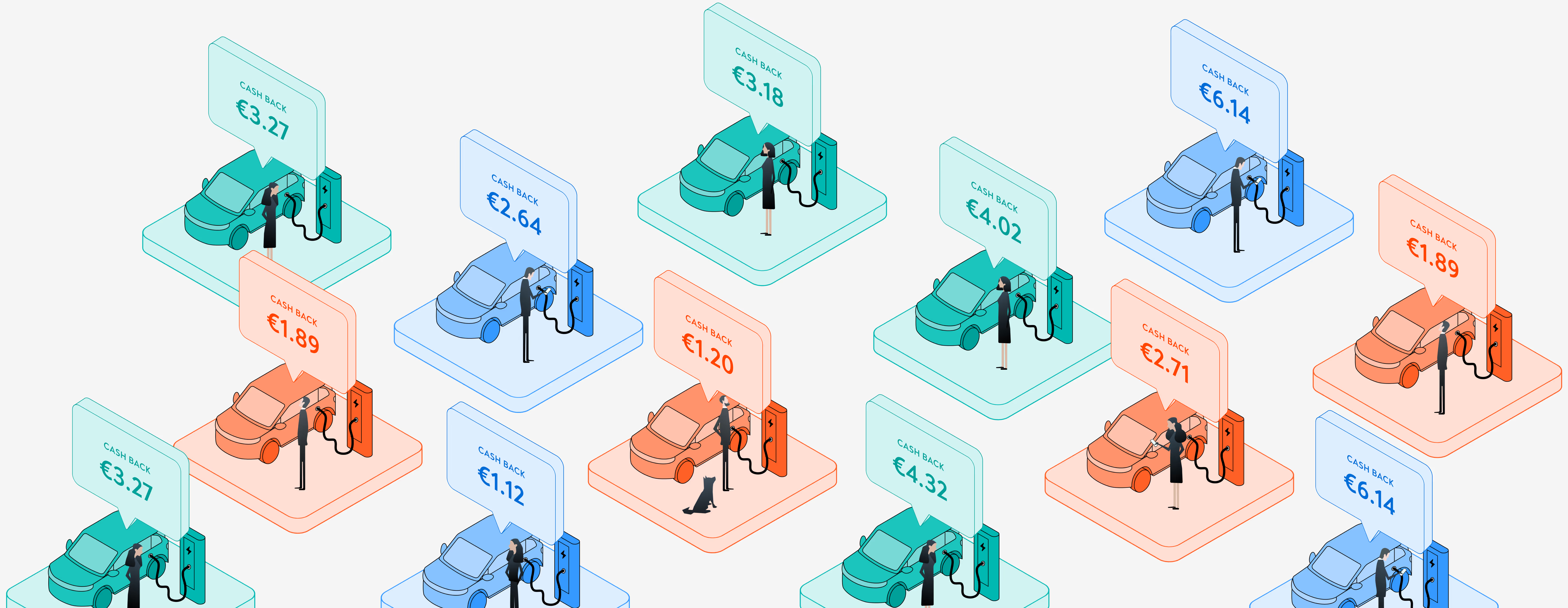
This approach already delivers measurable results. In the Netherlands, incentivised grid-aware charging shifts on average 67% of energy demand away from peak periods, demonstrating that drivers respond if they are rewarded for their flexibility. Aggregation turns this behaviour into a structured, system-level resource that grid operators can access and plan around.
If EV charging remains uncoordinated, it will continue to add pressure during peak periods and drive the need for more restrictions or infrastructure upgrades. If aggregated and actively managed, the same demand shifts to moments when capacity is available, improving utilisation and reducing local constraints. With the introduction of V2G in the near future, the aggregation of drivers will become even more critical, as EVs move from shifting demand to supplying energy back to the grid.
